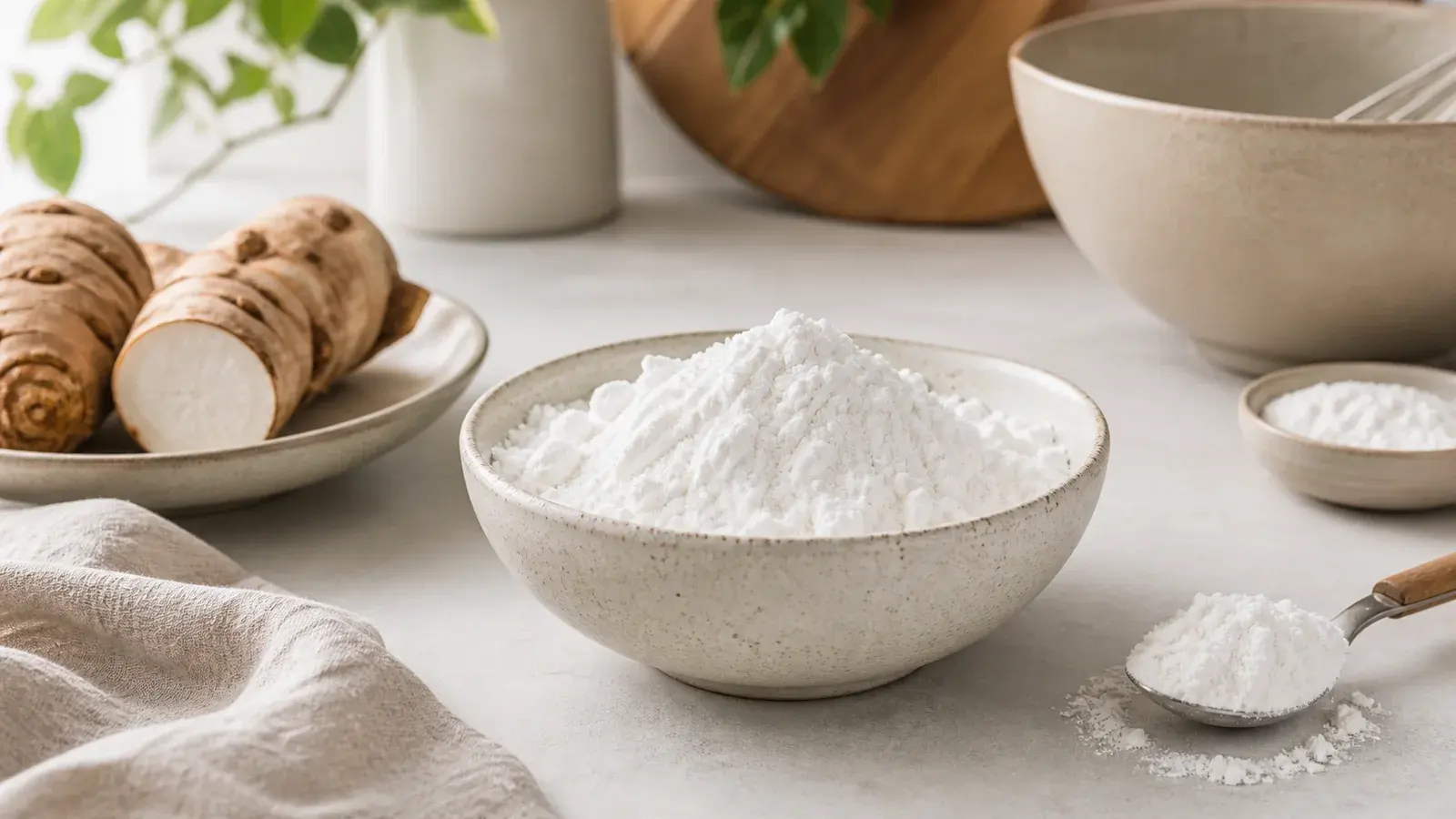
arrowroot starch gluten-free
Arrowroot Starch
Arrowroot starch — also sold as arrowroot powder or arrowroot flour — comes from the rhizomes (underground stems) of the Maranta arundinacea plant, native to the tropical Americas. The starch is extracted by washing, grating, and drying the rhizomes to yield a brilliant-white, fine powder. It has been used in Caribbean and Central American cooking for centuries, and in Victorian-era British cooking as an invalid food due to its digestibility. In modern GF cooking, arrowroot starch occupies a similar functional niche to tapioca starch and cornstarch, but with several notable advantages. It thickens at lower temperatures than cornstarch, produces a crystal-clear finish in sauces and glazes, and does not impart any starchy aftertaste. It is also notably easier on the digestive system, making it a preferred starch for those with IBD, IBS, or post-surgical digestive sensitivity. For GF flour blends, arrowroot starch contributes lightness and structure, performing similarly to tapioca starch. Many bakers use the two interchangeably in blends without noticeable quality difference.
What is it?
Arrowroot starch is a pure refined starch extracted from the arrowroot rhizome. Like tapioca starch, it consists primarily of starch (both amylose and amylopectin) with virtually no protein, fat, or fiber. It is grain-free, gluten-free, nut-free, dairy-free, and corn-free — one of the most allergen-friendly starches available. Its most distinctive characteristic is its thickening mechanism: arrowroot gelatinizes at a lower temperature than cornstarch (around 60–70°C / 140–158°F), meaning it can thicken cool or barely-warm liquids more effectively. It also produces a translucent, glossy gel rather than an opaque one.
How to use
As a thickener: - Use 1 tablespoon arrowroot starch to thicken 1 cup of liquid (equivalent to 1 tbsp cornstarch or 2 tbsp all-purpose flour). - Make a cold-water slurry first (equal parts arrowroot and cold water), then stir into the hot liquid. - Do not boil arrowroot-thickened sauces vigorously or for prolonged periods — extended high heat breaks down the starch and causes the sauce to thin out. Add arrowroot near the end of cooking. - Do not use in dairy-based sauces or those containing egg yolks — arrowroot causes a slimy texture in these applications; use cornstarch instead. In GF flour blends: Use arrowroot at 15–25% of total flour weight, similarly to tapioca starch. It lightens the texture of heavier flours. Crispy coatings: Coat proteins lightly in arrowroot starch before pan-frying or oven-roasting for a thin, crispy crust. Baby and weaning foods: Arrowroot has long been used as a gentle thickener for infant foods — its digestibility makes it suitable for sensitive young digestive systems (consult your pediatrician for guidance).
Substitutes
| Substitute | Ratio | Notes |
|---|---|---|
| Tapioca starch | 1:1 | Best substitute; very similar behavior in most applications |
| Cornstarch | 1:1 | Most common swap; produces slightly cloudier result |
| Potato starch | 1:1 | Works well in baking; not ideal for clear sauces |
| Rice flour | 2 tbsp per 1 tbsp arrowroot | Coarser; works in gravies but less silky |
| Kudzu starch | 1:1 | Traditional Japanese thickener; similar clear gel properties |
Safety notes
⚠️ Cross-contamination: Arrowroot starch is naturally gluten-free, but some suppliers process it in facilities that also handle grain starches. Look for certified gluten-free arrowroot when cooking for celiacs. ⚠️ Not for Prolonged High Heat: Arrowroot starch loses its thickening power when boiled vigorously or held at high heat for more than a few minutes. Use it in applications where you can finish thickening at the end of the cooking process and serve promptly. ⚠️ Not for Dairy-Based Sauces: Arrowroot starch reacts poorly with dairy proteins, producing a viscous, slimy texture rather than a smooth sauce. Use cornstarch or potato starch when thickening cream-based sauces or custards. ⚠️ Labeling Confusion: Products labeled "arrowroot powder," "arrowroot flour," and "arrowroot starch" are all the same thing. However, some products labeled "arrowroot" are actually made from other tropical starches (such as cassava). Check the ingredient list to confirm Maranta arundinacea as the source.
Where to buy
- Health food stores: Whole Foods Market, Sprouts, Natural Grocers (US); Holland & Barrett, Waitrose (UK) - Asian and Caribbean grocery stores: Affordable source; often sold in larger bags - Online (US): iHerb, Amazon, Bob's Red Mill, Anthony's Goods - Online (UK): Amazon UK, Real Foods, Planet Organic - Mainstream grocery: Available in the spice, baking, or natural foods aisle of larger supermarkets
Some product links may be affiliate links when a valid partner ID is configured. Always verify ingredients and labels before buying.
Storage
Store arrowroot starch in an airtight container in a cool, dry place. Shelf life is 2–4 years when kept away from moisture. Humidity causes clumping — reseal tightly after each use. Freezing is unnecessary for normal shelf life but is an option for very long-term bulk storage.
FAQ
Is arrowroot starch the same as cornstarch?
They serve similar thickening functions, but they are different ingredients. Arrowroot produces a clearer, glossier gel and works at lower temperatures. Cornstarch is more stable at high heat and works better in dairy-based sauces. They can often be used interchangeably at a 1:1 ratio for sauces and baking, though results differ slightly.
Can I use arrowroot starch in a GF flour blend?
Yes. Arrowroot starch works similarly to tapioca starch in GF flour blends, contributing lightness and a slightly tender crumb. Use it at 15–25% of total flour weight, blended with denser GF flours like rice flour, sorghum, or teff.
Does arrowroot starch freeze well?
Arrowroot-thickened sauces and soups do not always freeze and reheat well — the gel can break down during freezing and become watery upon thawing. For dishes you plan to freeze, cornstarch or potato starch-thickened sauces generally hold up better.
Is arrowroot starch good for people with IBS or digestive issues?
Arrowroot is widely regarded as one of the most digestively gentle starches available. It has historically been used as a food for people recovering from illness or digestive upset. For IBS sufferers, its lack of FODMAPs (compared with some other thickeners like guar gum) makes it a good choice, though individual tolerances vary.
What is the difference between arrowroot and tapioca starch?
Both are tropical root starches with very similar thickening and baking properties — they can be swapped 1:1 in most recipes. The main differences: arrowroot forms a slightly clearer gel, is gentler on the digestive system, and loses thickening power more quickly under prolonged heat. Tapioca starch is slightly chewier when used in baked goods.